Most Irish consultants running a private practice are working across systems that were never designed to connect. The referral arrives by Healthmail. The clinical note lives on a server in the clinic. Billing goes through a separate process entirely. If you are not in the building, you are not in the loop. Cloud-based practice management changes that — not because it is newer, but because it actually fits how a consultant practice works.
What "Cloud-Based" Means in Practice
A cloud-based system stores your practice data on remote, encrypted servers rather than a physical machine in your clinic. Your secretary can access the schedule. You can review a patient record from the hospital. Nothing is tied to a single device or a single location.
For a consultant who splits time between a private clinic, a hospital, and out-of-hours queries, this is not a minor convenience. You are not dependent on one computer, one local network, or your secretary being in the office to retrieve something you need. The practice travels with you, within whatever access controls you set.
Your Secretary Is Not Tied to One Machine
A medical secretary running a busy consultant practice spends a significant part of her day managing referrals, scheduling, and correspondence. In an on-premise system, she can only do that from a specific computer in a specific location. If she is working from home, covering from another site, or locked out of a crashed machine, the work stops.
In a cloud-based system, she logs in from wherever she is. Appointments can be updated while you are in theatre. A referral letter can be processed while you are between clinic and a ward round. The practice does not pause because the right person is not physically present at the right desk.
GDPR: Your Responsibility, Not Just Your Vendor's
Irish consultants are data controllers under GDPR. The responsibility for how patient data is stored, protected, and recovered sits with you, not your software provider. That distinction matters when you are choosing infrastructure.
A server in the back room of a private clinic that is not receiving regular security patches, that has no offsite backup, and that would be unrecoverable after hardware failure is a liability. Reputable cloud platforms use encrypted storage, two-factor authentication, and automated backups. If a device is stolen or a machine fails, your patient data is not lost with it.
For Irish private consultants, this is also a practical risk question: in the event of a data breach or GDPR complaint, the question a regulator will ask is whether you took reasonable steps to protect the data. On-premise servers you are not actively maintaining are a harder case to make.
The Billing Workflow Benefits Too
Irish consultant billing involves navigating VHI, Laya Healthcare, and Irish Life Health schedules, prior authorisation requirements, and the submission processes managed through billing partners like Medserv or Medpro. That workflow is already complex. When it sits in a separate system to your clinical notes and scheduling, reconciling a query on a patient account means switching between platforms, hunting for information, and hoping your secretary has both windows open.
A cloud-based platform that integrates scheduling, clinical records, and billing puts that information in one place. When a query comes in from an insurer, the information needed to answer it is in the same system as the original appointment and the clinical correspondence. That reduces the back-and-forth that currently lands on your secretary's desk or yours.
Cost: The Honest Comparison
On-premise practice management software typically involves upfront licensing, a physical server, and ongoing IT maintenance. When the server needs replacing, or the software needs an update that requires a site visit, there is a cost attached, often at short notice.
Cloud-based systems are subscription-based, maintained by the provider, and updated automatically. There is no dedicated hardware to replace and no IT contractor needed to keep the thing running. For a solo consultant practice or a small group, the total cost of ownership is meaningfully lower over a three-to-five-year horizon.
A Platform That Scales Without a Migration
If your practice grows, a second clinic location, an additional consultant joining the group, a new secretary covering a second site, a cloud system accommodates that by adjusting user accounts and access permissions. There is no hardware migration, no fresh installation, no downtime.
Getting the infrastructure right before you grow is considerably easier than changing systems mid-growth. The disruption of a migration during a busy period, re-training staff, transferring records, and restarting billing workflows is a real cost. Building on a scalable platform from the start avoids it.
The Practical Takeaway
Cloud-based practice management is not a trend. It is the architecture that allows a consultant practice to function properly across locations, devices, and team members without IT overhead or single-point-of-failure risk. For Irish consultants specifically, where practice management has historically run across fragmented systems, the move to the cloud is about connecting the workflow that already exists, rather than adding complexity to it.
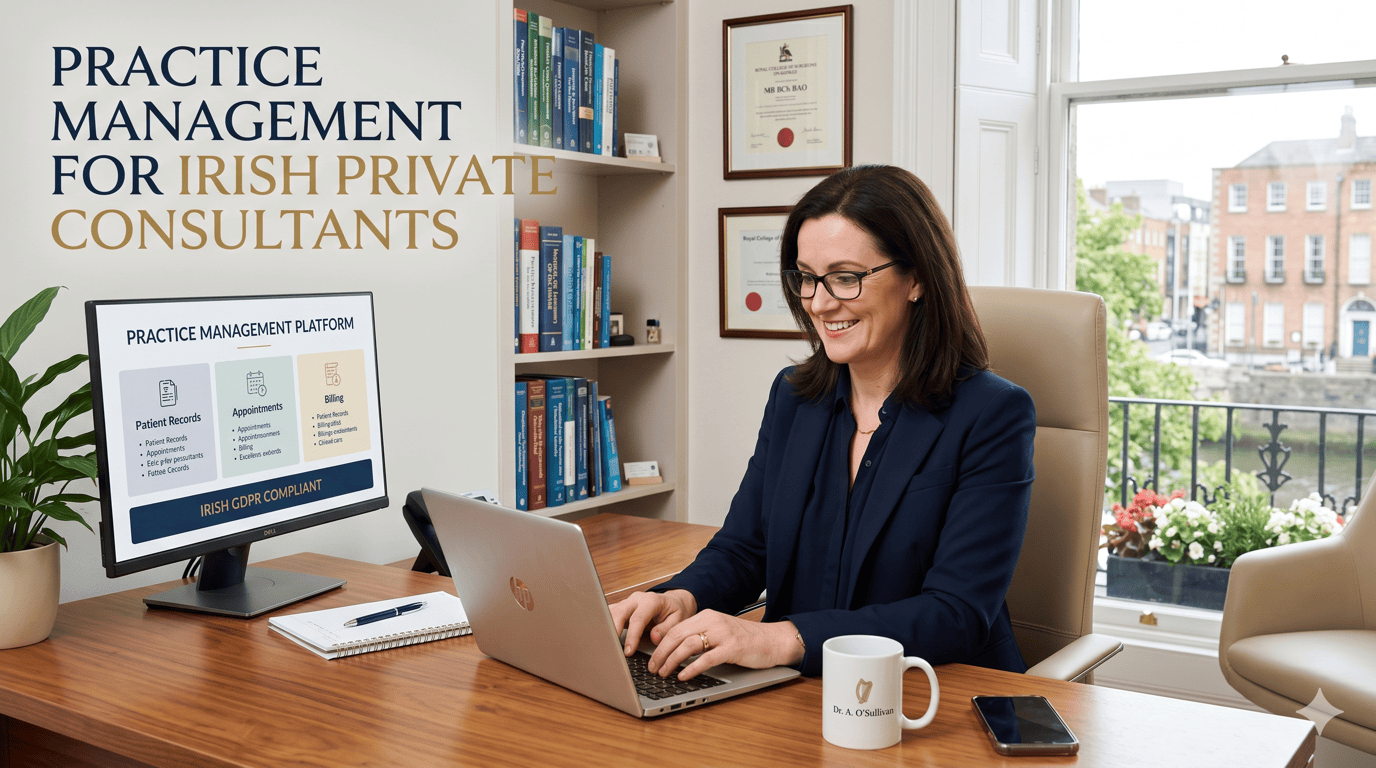
Enquiry Medical is built as a cloud-first platform for Irish private consultants, covering referral management, clinical correspondence, scheduling, and billing in one system. If you are reviewing your current setup or building a new practice, it is worth seeing how the workflow compares to what you are running now.
 No hidden fees | Scale your practice with clear pricing and packages →