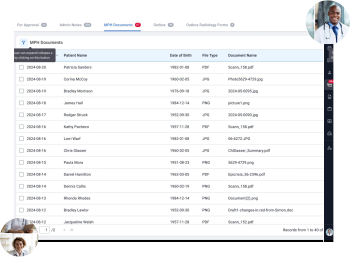
Running a private consultant practice involves considerably more administration than most consultants anticipated when they were finishing their training. Between managing referrals, dictating and issuing letters, obtaining pre-authorisations from VHI or Laya Healthcare, and submitting billing claims, the administrative layer around a consultant's clinical work is substantial — and it falls largely on one or two people to keep it moving.
Practice management software exists to carry that load. What varies enormously is whether a given system is built for the way Irish consultants actually work, or whether it is a generic platform that happens to be available here.
What Practice Management Actually Covers
In an Irish private consultant context, practice management covers four interconnected areas.
The first is referral and appointment management — capturing inbound referrals from GPs via HealthLink or Healthmail, triaging them, scheduling the patient, and issuing confirmation. Done manually across email, phone, and a separate calendar system, this alone can consume a significant part of a secretary's working day.
The second is clinical correspondence — dictating, drafting, approving, and issuing letters to referring GPs, to patients, and to other specialists involved in a patient's care. The quality and speed of this correspondence reflects directly on a consultant's reputation among referring GPs.
The third is billing and claims — generating invoices, submitting claims to VHI, Laya Healthcare, and Irish Life Health, tracking payments, and managing outstanding balances. Errors at this stage cost money and time.
The fourth is records management — maintaining a clear, GDPR-compliant record of every patient interaction, accessible when needed, auditable if required.
A practice management system should handle all four. Many systems handle one or two well and create workarounds for the rest.
The Multi-Site Problem Most Software Ignores
Most Irish private consultants work across more than one location. A morning list in a private hospital, an afternoon outpatient clinic in a separate facility, and administrative work handled remotely by a secretary who may not be on either site. Legacy desktop-based software was not built for this. It assumes a single location, a local server, and staff who are physically present.
Cloud-based practice management removes that constraint. The referral that arrived during a morning list is visible when you sit down for afternoon clinic. Your secretary can process pre-authorisations and prepare billing submissions from wherever they are working. Everyone is looking at the same system in real time.
For Irish consultants with shared secretarial arrangements, or those in the process of building a new practice, this is not a marginal benefit — it is a basic operational requirement.
What to Look For When Evaluating a System
Not all practice management platforms are equal, and not all of them are designed with Irish private practice in mind. Before committing to a system, the questions worth asking are straightforward.
Does it integrate with HealthLink and Healthmail? These are the standard clinical messaging platforms in Ireland. A system that does not connect to them creates manual duplication that defeats the purpose of using software at all.
Does it support Irish insurer workflows? Generating pre-authorisation requests, submitting claims to VHI, Laya, and Irish Life Health, and tracking reimbursement status should be built into the billing module — not handled by exporting data to a separate system.
Is it GDPR-compliant by design? Patient data held in Irish private practice is subject to GDPR under both Irish and EU law. The system should provide encrypted storage, defined access controls, audit logs, and a clear data retention policy. Platforms designed primarily for US practices are built around HIPAA, which is a different framework with different defaults.
What does the full cost look like? Monthly subscription cost is only part of it. Training, onboarding, ongoing support, and whether there are long-term contract obligations all affect the real cost of switching systems.
Is there a trial period? Any reputable system should allow you to test it against your actual workflow before you commit.
Where AI Is Starting to Change the Workflow
Artificial intelligence is beginning to have a practical effect on clinical administration, and the most useful application for consultants currently is AI-assisted documentation. An AI scribe that listens to a consultation in real time and generates a structured draft clinical letter removes one of the most time-consuming steps in a consultant's post-clinic workflow.
This is not a speculative development. The technology exists, it is being used in practice, and the EU AI Act is establishing the regulatory framework that will govern how it operates in clinical settings in Ireland and across Europe. Consultants evaluating practice management systems now should ask whether the platform has a roadmap for this, and whether that roadmap is being developed with clinical governance in mind.
Why the System You Choose Matters More Than It Might Appear
A practice management system shapes how efficiently your secretary works, how quickly letters reach referring GPs, how promptly claims are processed, and how your practice appears to patients and referrers. A system that is difficult to use, poorly supported, or not built for Irish workflows does not just cause frustration — it creates administrative drag that compounds over time.
Enquiry Medical is built specifically for Irish private consultants, covering referrals, clinical correspondence, and billing in a single system designed around Irish insurer workflows, HealthLink integration, and GDPR compliance. If you are setting up a new practice or reviewing your current setup, it is worth seeing how the workflow compares to what you are using now.
 No hidden fees | Scale your practice with clear pricing and packages →