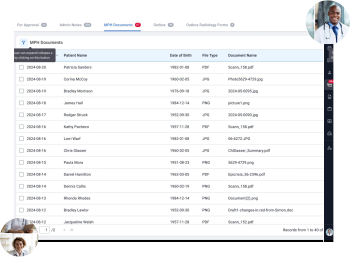
Most Irish private consultants operate across at least two sites — a private clinic and one or more private hospital lists. The patient's record rarely follows them cleanly. A letter from the referring GP arrives in Healthmail, the clinical note lives in a dictation system or a desktop folder, and the last consultation summary is somewhere in a filing cabinet the medical secretary has colour-coded her own way. It works, until it doesn't.
Digital patient records are not a new idea. What is newer — and still underused in Irish private practice — is having those records structured, complete, and accessible in a way that actually matches how a consultant's day runs.
The Medico-Legal Case Writes Itself
A consultant's patient chart is not administrative paperwork. It is the contemporaneous record of clinical decision-making. In the event of a complaint to the Medical Council, a legal claim, or a query from a private insurer, the chart is your primary evidence. A fragmented or incomplete record — or worse, a note that was never written because the dictation never got typed — is a significant exposure.
The discipline that comes with a structured digital record is a clinical governance argument as much as an efficiency one. When every consultation generates a dated, searchable note, with allergies, medication lists, and relevant history in a fixed location, the record actually reflects what happened. That matters when you are reviewing a patient six months later, and it matters considerably more if that patient ever becomes a complaint.
What Your Medical Secretary Actually Needs
The practical burden of managing patient information falls largely on your medical secretary. She is managing appointment bookings, processing insurer pre-authorisations, chasing referral letters, and preparing charts for clinic. If the patient record is spread across a paper file, a shared drive, and a separate billing system, that workload multiplies with every inefficiency.
A complete digital chart — one that holds the referral correspondence, the clinical notes, the investigation results, and the billing history in a single location — changes what is possible in that role. A pre-authorisation query from VHI or Laya can be answered from the record without pulling a physical file. A GP requesting an update on a shared patient can be responded to with the relevant note already to hand. The time saving is real, and it is your secretary's time, not yours.
Access Across Sites Is Not a Luxury
If you run clinics in more than one location — a hospital consulting suite on Tuesdays and a private clinic on Thursdays, for example — the question of which patient record is where becomes a logistical problem fast. Cloud-based digital records, accessed securely from any device, solve this without requiring any particular infrastructure in each location.
This also matters for continuity when your secretary is on leave, or when a locum needs to manage queries on your behalf. A complete, structured record accessible with appropriate permissions is a basic operational requirement for a practice of any size.
GDPR Is Not Optional
Patient data held in private practice is subject to GDPR, and the obligations are not trivial. Physical records create exposure — files can be mislaid, accessed inappropriately, or lost. Digital systems with proper access controls, audit trails, and encryption offer a significantly stronger compliance position. Given the Irish Data Protection Commission's increasing enforcement activity, this is not a hypothetical risk.
The practical point for consultants is straightforward: if you are holding patient data in a format you cannot demonstrate is secure, that is a problem waiting to materialise. A properly structured digital record system is part of what GDPR compliance in private practice actually looks like.
The Record Is the Practice
The patient chart is not a byproduct of the consultation — it is the foundation of everything that follows. The letter to the GP, the insurer submission, the follow-up booking, the medico-legal correspondence: all of it depends on what is in that record and how quickly it can be retrieved.
Private consultants who still rely on fragmented systems are not making a principled stand against technology — they are absorbing a hidden administrative cost every day and carrying a medico-legal exposure they may not have quantified.
Enquiry Medical is built around the clinical record as the centre of the practice, with referral management, clinical documentation, and billing connected from that single point. If you are reviewing your current setup, it is worth seeing how that structure works in practice.
 No hidden fees | Scale your practice with clear pricing and packages →