 No hidden fees | Scale your practice with clear pricing and packages →

Article - 4 min read
Why Private Patients Don't Return — And What to Fix
Learn proven digital marketing and engagement strategies to keep patients returning to your clinic.

Admin
June 01, 2025

Article - 4 min read
Learn proven digital marketing and engagement strategies to keep patients returning to your clinic.
Admin
June 01, 2025
Easy-to-use scheduling, billing, patient records, and analytics
What’s your email? Start TrialMost consultants assume that if a patient leaves the consultation satisfied, they'll come back when they need to. They often don't. Not because of the clinical outcome — but because of what happens in the days after they walk out of the room.
A letter that takes two weeks to reach the GP. A reminder that was never sent. A voicemail left with the rooms that wasn't returned until the following afternoon. For a private patient, these aren't minor inconveniences — they become reasons to ask their GP for a different referral next time.
The letter after the consultation is the most visible measure of how a consultant's practice operates — visible to the GP, to the patient, and increasingly to the insurer. A letter dispatched via HealthLink or Healthmail within 24 hours tells the referring GP that the referral was handled professionally. A letter that arrives a fortnight later, or not at all, says the opposite.
This is where most practice management falls down. The clinical note sits in one system. The letter has to be drafted in another. The secretary reformats, checks the insurer code, and sends through HealthLink as a separate step. The more systems in the chain, the more places a letter can stall — and the more it depends on the secretary having time to chase it that day.
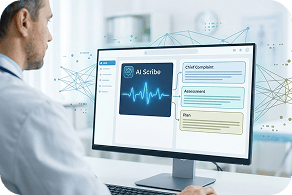
A system where the clinical note generates the letter directly, or where an AI Scribe captures the consultation and produces a structured draft in real time, removes most of that delay. The GP gets timely correspondence. The patient gets the impression that the practice is competent. Both come back.
DNA rates in private practice don't get talked about much, but they are a real cost — to the consultant's schedule, to the patient's treatment pathway, and to the overall throughput of the clinic. A private patient who misses an appointment and doesn't hear from the rooms for a week has usually already moved on.
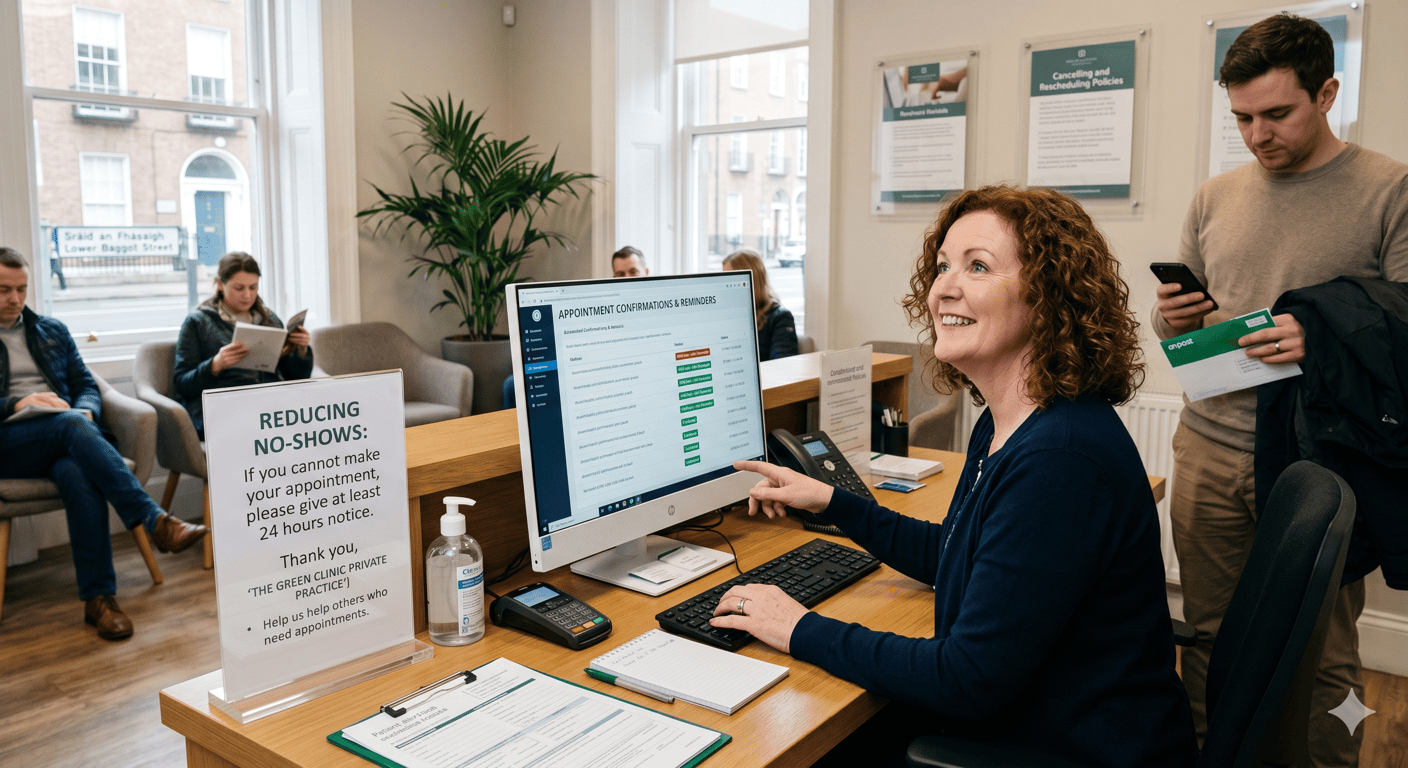
Automated reminders sent by text or email at 48 and 24 hours before the appointment are now standard expectation. Patients with VHI or Laya coverage have access to multiple consultants in most specialties; the administrative experience is part of what distinguishes one practice from another.
The reminder itself doesn't need to be elaborate — patient name, appointment time, location, and a way to confirm or cancel. The goal is simply to close the gap between booking and attendance, without requiring the secretary to run a manual process every morning.
The busiest period in most consultant rooms is 9am to 11am — patients calling to confirm appointments, ask about results, or check whether a letter has gone to their GP. Every one of those calls is administrative overhead that doesn't have to exist.
When patients can see their appointment details, receive automated confirmations, and know that their correspondence has been dispatched — without calling the rooms — the secretary's time frees up for the work that actually requires clinical knowledge or judgment. Insurer authorisations with VHI. Complex scheduling. GP queries that need a considered response.
Practice management software that handles patient communication as part of the core workflow — rather than as a bolted-on module — is what makes this consistent. Systems that require the secretary to operate two or three platforms simultaneously get used inconsistently. Reminders go out some of the time. Letters get delayed. The patient experience becomes uneven in ways that are hard to trace but easy for patients to feel.
For most consultants, patient volume flows from a relatively small number of referring GPs. A GP who sends fifteen patients a year to a particular cardiologist or orthopaedic surgeon does so because the correspondence is reliable, the patient comes back with a clear plan, and the consultant responds when something needs clarifying.
Digital engagement, in the consultant context, is not about apps or loyalty schemes. It is about whether the GP gets a letter within 24 hours of the consultation, whether the patient knows when their next appointment is, and whether the insurer authorisation is processed before the procedure date. The practices that retain patients — and retain referring GPs — are the ones where nothing falls through the administrative cracks. That is a workflow outcome, not a marketing outcome, and it comes from having a system where the clinical and administrative sides are connected rather than running in parallel.
The features that matter for an Irish consultant aren't complicated:
These are not advanced features. They are the baseline of what a well-run private practice looks like to a patient and to a referring GP. The only question is whether the software makes them straightforward or makes them effortful.
Enquiry Medical is built around this workflow — designed specifically for Irish private practice, with HealthLink integration and billing set up for VHI, Laya Healthcare, and Irish Life Health. If you're reviewing your current setup, it's worth seeing how it compares.
Share Article:
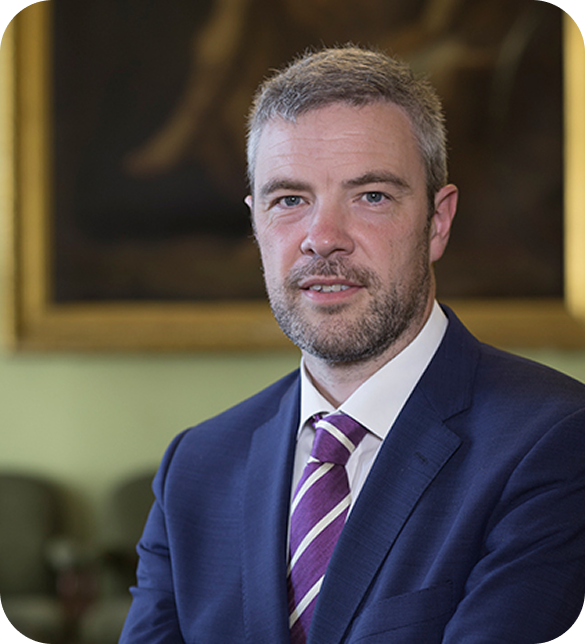
Conor Shields is a practising Consultant Surgeon, former Chief Clinical Information Officer, and founder of Enquiry Medical — the practice management platform he built because the existing tools weren’t good enough.

June 4, 2025
Most private consultants carry a patient's history across three systems that don't talk to...
June 3, 2025
Every empty slot in a private clinic is a direct financial loss. Here's how structured pat...

April 14, 2026
Setting up a private consultant practice in Ireland comes with no handbook. This post cove...