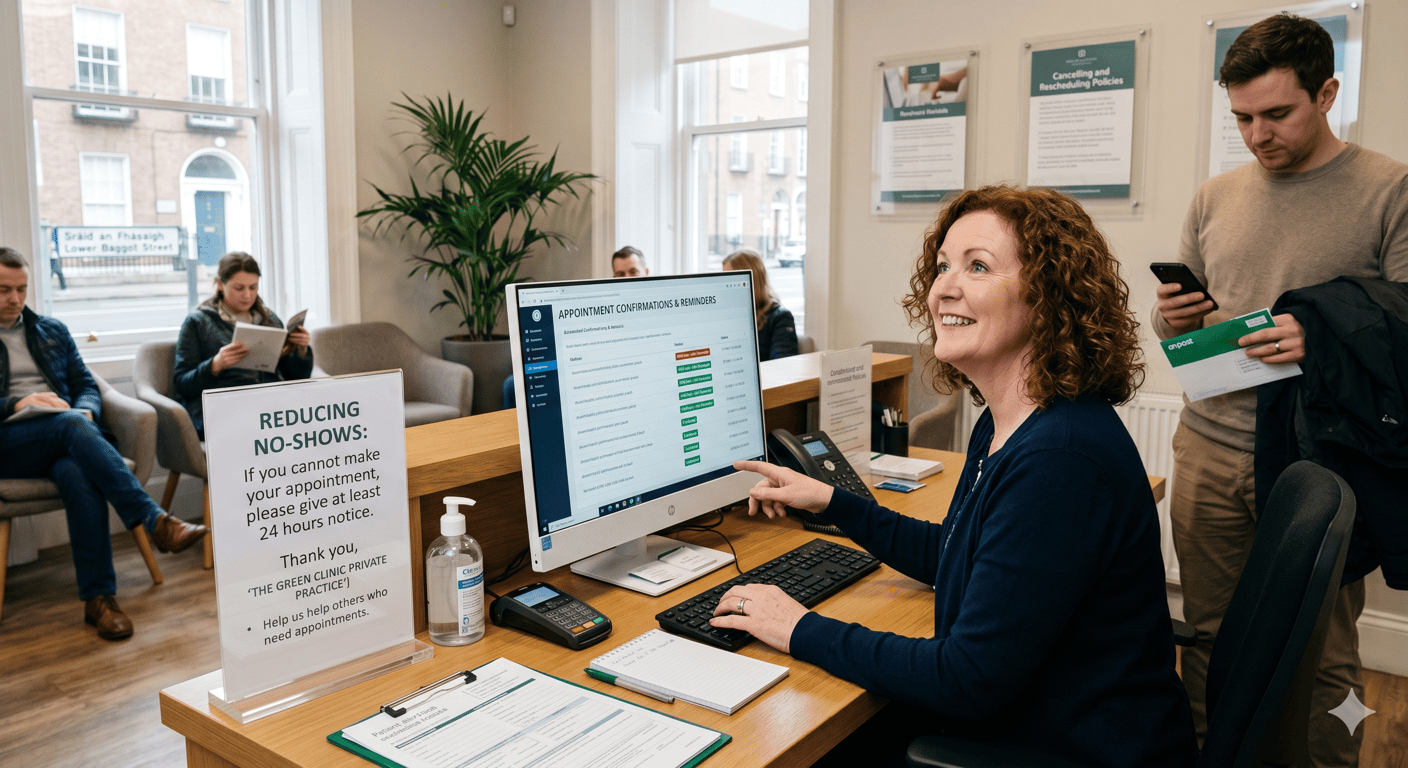
A no-show in a busy public list is an inconvenience. A no-show in a private clinic is a specific, unrecoverable financial loss — a 30-minute slot that cannot be resold, a theatre booking that cannot be reassigned, a referral relationship that gets no outcome. Irish consultants running mixed or private-only practices absorb this cost quietly, often without ever measuring it. Most of it is preventable.
What a DNA Rate Actually Costs You
Did-not-attends (DNAs) in private outpatient practice in Ireland typically run at somewhere between 10 and 20 percent across specialties, depending on the waiting time between booking and appointment. The longer the gap, the higher the DNA rate — patients book in good faith, then life intervenes, and without a prompt they simply don't show.
For a consultant running two private outpatient lists per week at, say, eight to ten slots per list, a 15 percent DNA rate represents roughly three missed appointments per week. Across a year, that is a material figure — and that is before factoring in the knock-on effect on follow-up scheduling and procedure bookings.
The problem is not patient attitude. It is the absence of a prompt at the right time.
Automated Reminders: Simple, But They Have to Be Right
The evidence on appointment reminders is not complicated — they work. An SMS sent 48 hours before an appointment, followed by a second prompt the morning of, substantially reduces the DNA rate in most outpatient settings. This is not novel technology. The question is whether your practice management system is doing it automatically, or whether your medical secretary is doing it manually.
The manual approach does not scale. A secretary managing referral correspondence, insurance pre-authorisations, HealthLink letters, and billing queries does not have consistent bandwidth to phone or text every patient before every clinic. When the reminder system is built into the practice management platform and triggers without human intervention, it happens reliably — including on the days the clinic is busy, short-staffed, or the secretary is on leave.
Reminders should also carry the right information: date, time, location, and a clear route to reschedule if needed. A patient who cannot attend but cannot easily cancel will simply not show. A patient who can reschedule in one step will often do so, giving you the slot back with enough notice to fill it.
Following Up After the Appointment
The consultation does not end when the patient leaves the room. In most consultant-patient relationships, there is a follow-up appointment, a procedure, or a review that needs to happen — and the interval between visits is where patients drift.
A structured follow-up system — whether that is a recall prompt at a defined interval, a post-visit communication confirming next steps, or a letter to the referring GP that keeps the referral loop intact — keeps patients on the pathway they need to be on. For surgical specialties in particular, the gap between outpatient review and procedure booking is where patients are most likely to disengage or seek a second opinion.
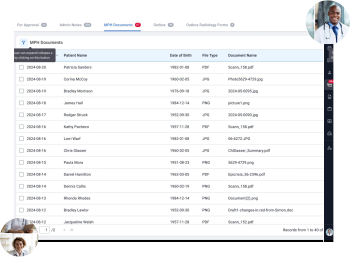
None of this requires a separate CRM bolt-on. It requires a practice management system where the patient journey — from GP referral to initial consultation to treatment to discharge — is tracked in one place, and where reminders and follow-up prompts are part of the workflow rather than an afterthought.
Your Practice Data Is Worth Reading
Most consultants have a reasonable intuition about which clinics run badly and which run well. Fewer have actual data. A practice management system that logs attendance, cancellation, and no-show patterns over time gives you something more useful than intuition — it gives you a basis for adjusting clinic length, booking intervals, and follow-up scheduling.
If your Monday outpatient list has a consistently higher DNA rate than your Thursday list, that is worth knowing. If patients referred from a particular GP have a shorter interval to attendance than others, that is useful referral data. If your procedure conversion rate from new referrals is declining, that is a clinical governance question as much as a practice management one.
The data is generated by the activity you are already doing. The question is whether your system surfaces it in a usable form.
The Practical Takeaway
No-shows and lost follow-ups are not inevitable. They are, in most cases, the product of systems that were not designed to prevent them — booking platforms that do not send reminders, clinical records that do not connect to scheduling, billing systems that sit entirely outside the consultation workflow.
Enquiry Medical is built around the full consultant workflow — referral to consultation to billing — with patient communication built in rather than bolted on. If you are running a private practice in Ireland and your current system is not reducing your DNA rate, it is worth seeing how it works.
 No hidden fees | Scale your practice with clear pricing and packages →