Private practice in Ireland runs on clinical expertise and administrative friction in roughly equal measure. Most consultants did not train for a decade to spend significant portions of their week chasing pre-authorisation approvals from Laya, reconciling billing queries, or waiting for dictation to come back from a typing service. But that is what the current setup produces for a large number of Irish consultants — a patchwork of systems that each do one thing adequately and nothing together particularly well.
Technology does not solve this by being impressive. It solves it by removing specific friction points from a specific workflow. The question worth asking is not whether technology is changing medicine — it obviously is — but which parts of the Irish consultant's working day it can actually improve.
The Administration Problem Is a Workflow Problem
The paperwork burden on Irish private consultants is not random — it follows a predictable path. A referral arrives. An appointment is booked. A consultation happens. A clinical note needs to be produced. A letter goes to the referring GP. An insurer claim is submitted. A payment is chased, or not. Multiply that by forty patients a week and the administrative overhead becomes substantial.
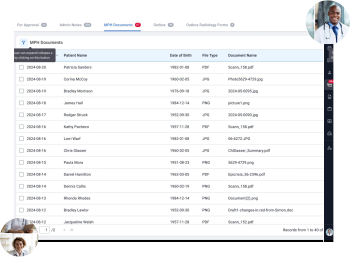
The inefficiency is almost never in any single step. It is in the gaps between systems. The referral arrives in Healthmail and someone manually transfers the patient details into a booking system. The clinical note is dictated, typed by a medical secretary, and then reformatted for a GP letter. The billing happens in a separate system that does not know what was coded in the clinical record. Each step is workable in isolation. Together, they create a practice that spends more time on data re-entry than on clinical decision-making.
What AI Scribing Changes in the Consultation Room
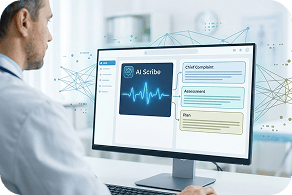
The most significant technology shift for consultant practice in the last two years is not scheduling software or patient portals. It is AI scribing — the ability to generate a structured clinical note from a live consultation without a dictation step and without a typing queue.
For a consultant doing a busy outpatient list, the practical implication is direct. The note is drafted in real time. By the time the patient has left the room, the letter to the GP is structurally complete and ready for review. The medical secretary's role shifts from transcription to quality review and dispatch. The dictation backlog — a feature of almost every busy private practice — disappears.
This matters beyond efficiency. A contemporaneous, structured note produced at the point of consultation is a stronger medico-legal record than one typed two days later from a dictation that was recorded in a noisy corridor. The clinical governance argument for AI scribing is at least as strong as the time-saving argument.
Billing Integration Is Where Practices Actually Lose Money
Irish private consultants bill through a combination of self-pay, VHI, Laya Healthcare, and Irish Life Health, often with different fee schedules, different pre-authorisation requirements, and different submission formats. Managing this manually, or through a billing system that operates independently of the clinical record, creates predictable errors — wrong procedure codes, missing authorisation numbers, delayed submissions.
The connection between what was done clinically and what gets billed should be automatic, not a manual reconciliation exercise. When billing partners like Medserv or Medpro are integrated with the clinical record, the submission reflects the actual consultation. Queries from insurers can be answered from the record rather than from a separate paper trail. Payment tracking sits alongside the patient's history rather than in a spreadsheet someone maintains separately.
For consultants who have never had this integration, the time saving when it is in place tends to be visible within the first week.
What Technology Cannot Replace
It is worth being direct about what practice management software does not do. It does not improve a consultation. It does not replace clinical judgement. And it does not run a practice without a competent medical secretary who understands how the consultant works.
What it does is remove the structural inefficiencies that accumulate around good clinical work — the unnecessary re-entry of data, the chasing of records that should already be accessible, the billing errors that arise when clinical and administrative systems are not connected. For an Irish private consultant operating across two or three sites, that reduction in friction is meaningful in practical terms.
The Cost of Not Changing Is Also Real
Most Irish consultants running on legacy systems — or on a configuration that has not been reviewed in years — are not in crisis. The practice functions. Patients are seen. Bills are sent. But the hidden cost of the current setup accumulates in the hours a medical secretary spends on re-entry, in the billing that falls through the gaps, and in the medico-legal exposure created by incomplete or delayed documentation.
The technology to address those specific problems exists and is available to Irish private practice now. The question is whether it is worth the disruption of changing.
Enquiry Medical is built to address exactly this workflow — referral to consultation to billing in a single system, built by a consultant who still does lists. If you are considering your options, or looking at alternatives to your current setup, it is worth seeing how the integrated approach works in practice.
 No hidden fees | Scale your practice with clear pricing and packages →