The administrative workload in Irish private practice does not feel random when you look at it closely. The same tasks take longer than they should, every week, in almost every consultant practice. Referrals that arrive and sit unprocessed. Pre-authorisation requests that require chasing. Letters that are dictated on a Tuesday and issued on a Thursday. Claims that go out late because the billing module is not connected to the clinical note.
These are not problems that resolve themselves with better personal organisation. They are workflow problems, and most of them have a structural fix.
Stop Processing Referrals Twice
In many Irish consultant practices, a GP referral arrives via HealthLink, gets printed or saved, and is then manually re-entered into the scheduling system. That is the same information being handled twice by the same person. It should happen once.
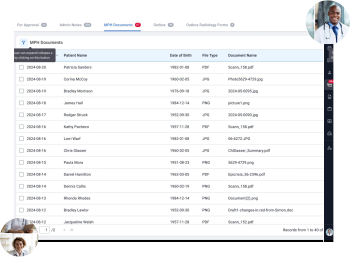
A practice management system that integrates with HealthLink should pull the referral directly into the patient record, pre-populate the demographic data, and allow your secretary to schedule the appointment without leaving the system. If your current setup requires re-keying any data that arrived in a HealthLink message, that is recoverable time.
Template Your Clinical Correspondence
The variation between a new patient letter and a follow-up letter for a given specialty is smaller than the time spent recreating both from scratch suggests. Most of what changes is the clinical content. The structure, the GP's address, the patient demographics, the sign-off — these are fixed or auto-populated.
Building structured letter templates by appointment type is one of the highest-return investments a consultant practice can make in its own efficiency. A template that carries forward the relevant history, pre-populates from the clinical note, and requires the consultant to review and amend rather than compose from scratch can reduce per-letter time significantly. At scale, across a full outpatient list, that reduction is meaningful.
Connect Your Clinical Notes to Your Claims
One of the most consistent sources of billing delay in Irish private practice is the gap between the clinical note and the insurance claim. The procedure was performed and documented. The diagnosis code exists. But submitting the claim requires someone to go back into the note, identify the relevant codes, and enter them into a separate billing module or, worse, a separate system entirely.
This should be one step, not three. A well-configured practice management system maps the clinical documentation directly to the billing workflow. The operative note generates the claim. The diagnosis recorded in the consultation note populates the submission to VHI, Laya Healthcare, or Irish Life Health. If your current system does not do this, you are carrying an administrative overhead on every single patient encounter.
Manage Pre-Authorisations as a Process, Not a Task
Pre-authorisation requests to Irish private insurers are a known, recurring part of the administrative workload in most consultant practices. They are also one of the tasks most likely to create delays when not managed systematically.
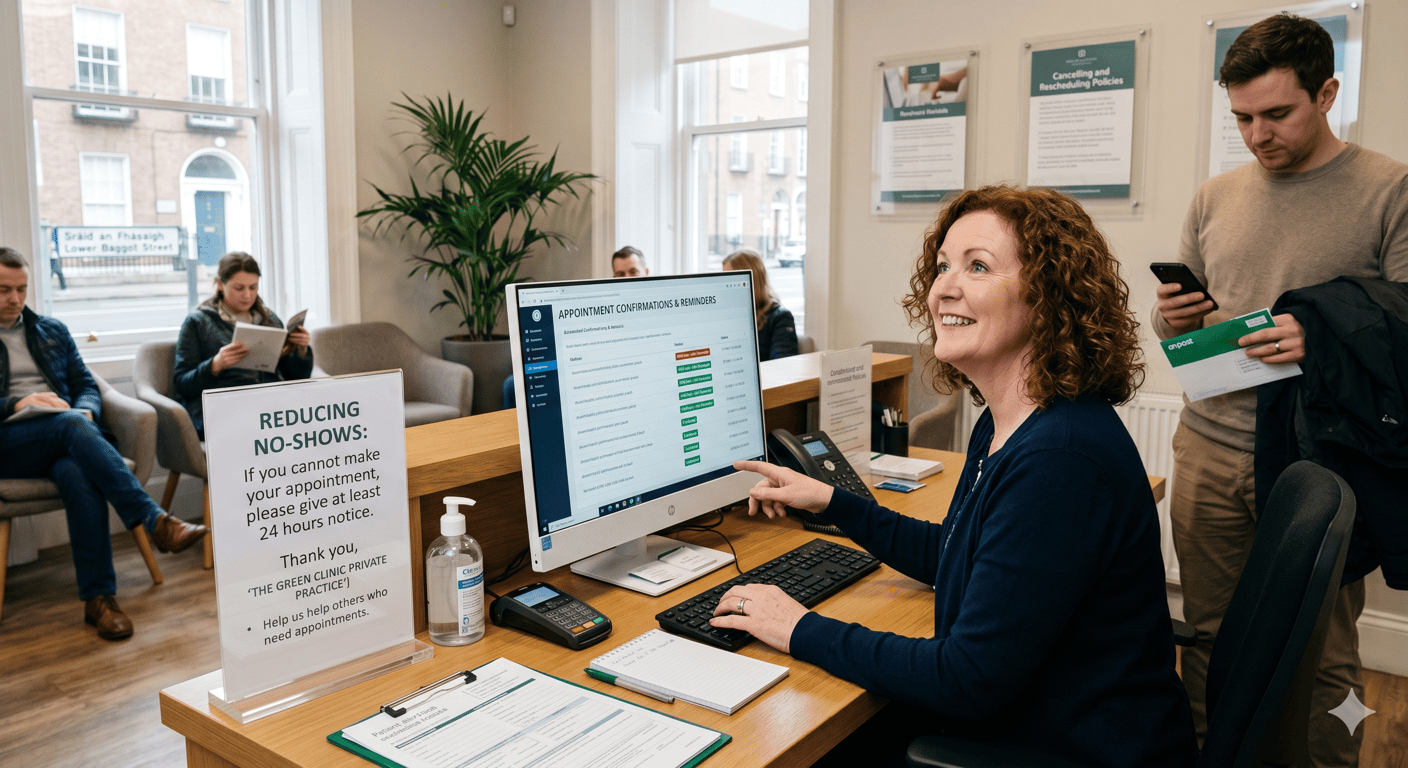
Treating pre-authorisations as individual tasks — submitted when needed, chased when remembered — creates gaps in cash flow and unnecessary back-and-forth with insurers. Managing them as a structured process, with clear responsibility, standard timelines, and visibility of outstanding requests, removes the variability. Your secretary should be able to see at a glance which patients have authorisation confirmed, which are pending, and which need follow-up — without having to check individually.
Use AI-Assisted Documentation Selectively
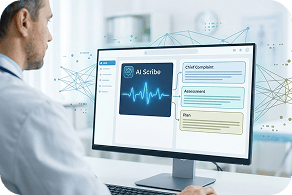
AI transcription tools that generate draft clinical notes from a consultation recording are now practical and available. Used appropriately, they reduce the post-clinic documentation burden considerably. The consultant reviews and approves rather than composes, and the letter is ready to issue before the clinic ends rather than the following morning.
The qualifier "selectively" matters. AI-generated documentation requires clinical review before anything is issued. It does not replace clinical judgement, and in any case that carries medicolegal weight, the structured SOAP note composed by the consultant remains preferable. But for high-volume outpatient follow-up, where the clinical note is tracking progress against an established plan, AI assistance reduces one of the more time-consuming parts of the day without compromising the output.
Review Where the Time Actually Goes
The tips above target the most common time drains in Irish consultant practice. But the specifics vary by specialty and by how a given practice is configured. A surgical practice with a high operative volume has different bottlenecks to a physician practice running long outpatient lists.
If your practice management system has a reporting function, use it to look at where time is actually being lost — how long letters take from dictation to dispatch, how quickly claims are submitted after clinic, how much time is spent on referral processing per week. The answer usually points directly to the process that needs fixing.
Enquiry Medical is built around the workflows that consume time in Irish private consultant practice — referral management, clinical correspondence, insurer billing, and GDPR-compliant records, in a single connected system. If the bottlenecks described here sound familiar, a demonstration against your own practice workflow is the most useful place to start.
 No hidden fees | Scale your practice with clear pricing and packages →